Showing posts with label astronomy. Show all posts

Sunday, October 28, 2007

big bang cosmology

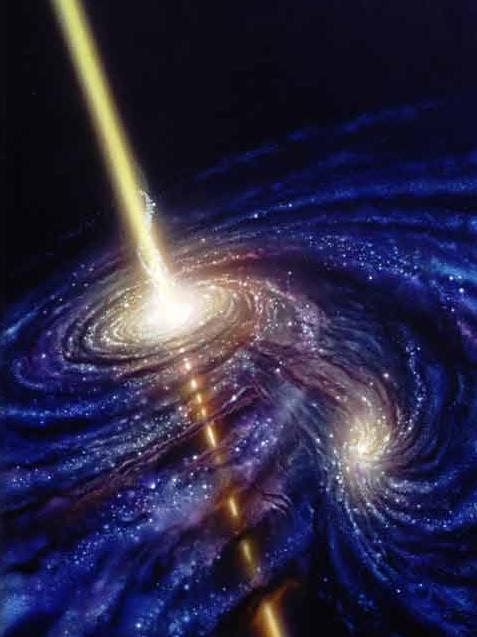
i was just reading about the big bang theory of how our particular universe began and thinking about how well this cosmology explains our universe.


the most successful test of the theory is the measurement of the cosmic microwave background (CMB) radiation (see nobel prize in physics, 2006). The CMB is the very first light we know how to "see" after the big bang, and it only became visible 300,000 years after the big bang happened. it's fantastically exciting that the big bang theory matches so well to the experiment we performed (remember: science it works, bitches!), but there remain many unanswered (and currently unanswerable) issues to understand!

what existed before the big bang? what is dark energy? immediately after the big bang, why were there 10,000,000,000 (ten billion) anti-particles for every 10,000,000,001 (ten billion AND ONE) particles? i keep reading and learning more, trying to understand life, the universe, and everything, but i'm left with unsatisfactory justifications to explain away problems.

the WMAP cosmology tutorial states,

It is beyond the realm of the Big Bang Model to say what gave rise to the Big Bang. There are a number of speculative theories about this topic, but none of them make realistically testable predictions as of yet.

well, that sucks!! i mean, maybe there are other universes, just as there are surely life forms elsewhere in our universe... we just can't prove it (yet?). we dont know how to prove it because we havent developed the ability to find it.

creating "speculative theories" about these lingering questions over a few beers is quite fun, but in my mind it always comes back to the question of "how do we test the theories?" in order to know whether the big bang model of the universe is completely correct, we must develop ways to detect other remnants from the earliest parts of the universe.

but i got nothing.

what are the tests? how can we "see" anything earlier than 300,000 years after the big bang? will dark energy give us a clue? what the hell is dark energy? it's the stuff that is 70% of all the stuff that is our universe, but how does it manage to accelerate the expansion of the universe? (... if it does?) we're currently developing the technology for experiments that will potentially be able to detect the bizzaro entity called dark energy... but are there any other tests we can perform?


i still feel somewhat unsatisfied about the finer points of big bang theory (the answer 42 seems way easier to just accept, doesnt it? but it's ultimately way less satisfying).


first art work by vista arts.

Tuesday, July 31, 2007

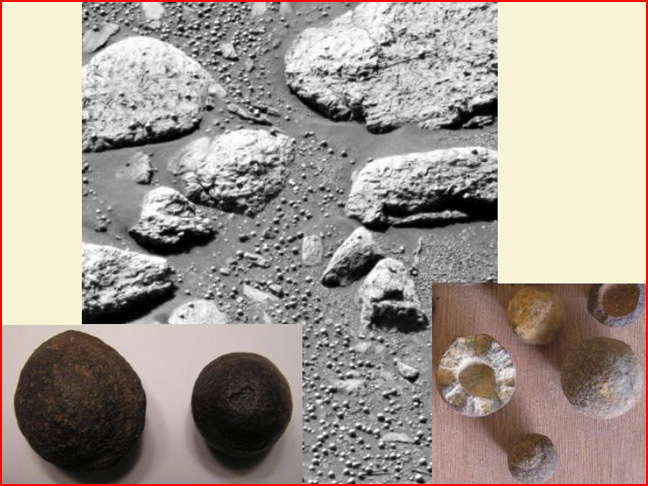
mars blueberries

the informative space.com put together a list of the top 10 most amazing things discovered by the mars rovers, spirit and opportunity. everyone likes their lists and i think it's great that there's finally one about my favorite robots!

items included on the list are the first meteorite ever found on another planet and the possibility that mars smells like rotten eggs from all the sulfur on its surface!! my personal favorite discovery by the rovers was definitely the blueberries!


Scientists aren't completely sure what causes these little rocks to have such spherical shapes and pure contents, but they have a good theory. the BB-sized spheres are mostly made of hematite, an oxide of iron. if the martian spheres are formed similarly to blueberry stones found on earth in utah, then over time, water seeps through cracks, spaces and pores in the martian dirt.... eventually, the hematite dissolves out of the water and the weathering of the area causes the shape (or something like that... geologists, help me out?). so this would mean.... that there was once flowing water on mars!


cool stuff. i havent read much more about these blueberries recently. anyone else seen articles about them? anyway, neat top 10 list and finally some good press for NASA!

Thursday, May 31, 2007

carnival of space

i'm really enjoying the carnival of space series... a weekly collection of blogs about anything and everything that has to do with... wait for it... space!! the 5th installment of the carnival of space is now up and running!

i contributed a post about heliocentrism and i really enjoyed the post from universe today about dark matter annihilation at the center of the milky way.

Wednesday, May 9, 2007

is there other life in the universe?

i believe life... in some form... exists somewhere in the universe other than just on earth. the universe is just too big for us to be the only life!! we developed on one planet, among nine eight planets that orbit around one star in the milky way galaxy which harbors ~400 BILLION other stars. the milky way is only one galaxy among the BILLIONS of galaxies in the universe, each containing BILLIONS of stars. any of those stars could have planets, but planets are really hard to find!

i'm certain life exists *somewhere* in that vast volume of space, but that's exactly the difficulty in finding life.... there are so many galaxies and stars so where do we look? what do we look for? since we live on a planet, we can easily deduce that the best place to look is on other planets! as of today, we've detected 233 planets outside of our solar system and its cool that we finally found an earth-like planet that exists in a region around a star with a temperature to support liquid water!

life on earth has existed for 5 billion years but the universe is about 13.7 billion years old. some life out there could have just began in the last billion years or less, or some planets could have harbored evolving life forms for twice as long as the earliest known life forms believed to be on earth! that raises interesting questions about what life on earth might look like in another 5 billion years (assuming life survives this destructive period in human existence)! consider that only 65 million years ago, dinosaurs dominated earth's surface!

communication with extraterrestrial lifeforms is a whole other issue. our chance of "communicating" with anything out there (in my opinion) will result from another civilization communicating with us. we've been sending off electromagnetic signals for, lets say, 100 years. the earliest signals are now 100 light years away from earth in all directions. within that sphere there are only ~30 stars. the new planet we just found is about 20 light years away... so it has received our earliest transmissions and has had ample time (over 20 years) to send a light signal back our way. We havent received any signals from this or any other planet accoring to the SETI Institute. our (unintentional) early electromagnetic signals have only reached a few dozen stars among the buhzillions that exist in the universe... and thats traveling at the speed of light!

so.... thats why i say our best chance for communication is from another life form having sent out a signal at some point in the past. let's say there's intelligent life on a planet on the other side of the milky way... about 40,000 light years away. if we receive a signal tomorrow from this distant planet, the signal will have been traveling from that planet for 40,000 years! we are ready with our return signal (of course!), which we send out immediately. that planet will start receiving our original signals in 39,900 years and then in 40,000 years, they will receive our response specific to their message. then it will take them 40,000 years to respond to us, etc....

another (more hopeful) option is that they will have detected our presence thru light detection or exploration of our neck arm of the milky way, in space vehicles that travel very very fast!!

my point is not to lose all hope of ever detecting another civilization... on the contrary, i think it is super exciting that we are detecting so many planets so rapidly right now!! my real point is that there *has* to be life out there somewhere is this unfathomably large universe of ours. probability says there should be life considering the volume and the fact that the chemistry that makes life possible on earth is extremely abundant throughout the universe. so let's keep looking and doing our best not to destroy our own successful and immensely special civilization while we are actively searching for those signals!!

Sunday, March 18, 2007

journey to a black hole

ever wonder what it would be like to journey near a black hole?? what does the approach to a point of infinite density and infinite gravity feel like?

here is a very cool interactive site with loads of great graphics...
Black Holes: gravity's relentless pull.

enjoy the journey!!